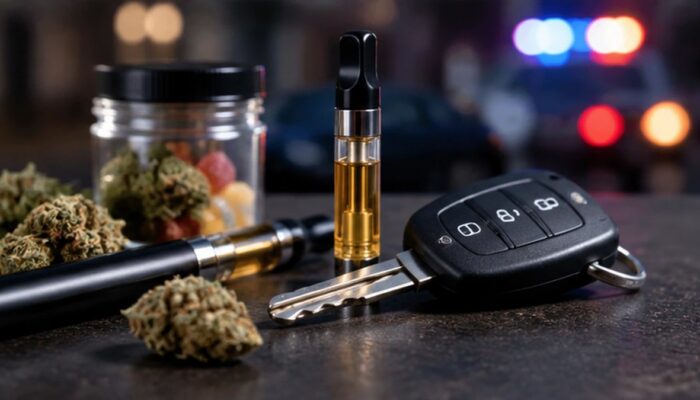
Yes. In Pennsylvania, using Delta-8, Delta-9 or another intoxicating hemp-derived THC product can still lead to a DUI charge—even if the product was purchased legally at a store or online.
The key point is that product legality and driving legality are different questions. Pennsylvania’s DUI statute focuses on what is in a driver’s blood and whether a drug impaired the person’s ability to drive safely. That means a package labeled “hemp,” “Farm Bill compliant” or “legal THC” does not create an automatic defense to a DUI case.
Why Can Hemp-Derived THC Still Lead to a DUI in Pennsylvania?
Pennsylvania recognizes more than one theory for a drug DUI.
Under 75 Pa.C.S. § 3802(d)(1), a driver may be charged under a per se controlled-substance theory if there is any amount of a Schedule I controlled substance—or a qualifying metabolite—in the person’s blood. Pennsylvania’s Controlled Substance, Drug, Device and Cosmetic Act lists tetrahydrocannabinols in Schedule I.
Separately, Section 3802(d)(2) prohibits driving while under the influence of any drug or combination of drugs to a degree that impairs the person’s ability to drive safely.
That distinction matters. A prosecutor may pursue a THC case based on the substance detected in a blood sample, actual impairment, or both, depending on the evidence.
What Is the Difference Between a Per Se THC DUI and an Impairment-Based DUI?
A per se case under Section 3802(d)(1) is primarily about chemical evidence. If the Commonwealth proves that a qualifying Schedule I substance or metabolite was present in the driver’s blood, it does not have to prove actual impairment in the same way it would under Section 3802(d)(2).
An impairment-based drug DUI is different. Under Section 3802(d)(2), the Commonwealth must prove that the drug affected the driver to a degree that impaired safe operation of the vehicle.
Evidence in an impairment case may include driving behavior, field sobriety testing, body-camera footage, statements to police, physical observations, toxicology findings and testimony about the effects of the substance.
This is why the exact charge matters. A driver who felt completely sober may still face a per se theory in some THC cases, while an impairment-based charge creates a different set of factual and evidentiary issues.
Can Delta-9 THC From Hemp Cause a Pennsylvania DUI?
Yes. Hemp-derived Delta-9 should not be treated as a DUI safe harbor.
A particularly relevant Pennsylvania case is Commonwealth v. Lockett, a 2025 nonprecedential Superior Court decision. The defendant argued that Delta-9 could come from hemp and pointed to the federal definition of hemp allowing cannabis material at or below the federal THC threshold. The court rejected that argument in the circumstances before it, explaining that the federal agricultural definition of hemp was not the controlling criminal-law question in the DUI prosecution. The case focused instead on the Delta-9 THC and metabolites found in the defendant’s blood under Pennsylvania law.
Because Lockett is nonprecedential, it should not be treated as a blanket rule resolving every future hemp-derived THC case. But it is a direct warning against assuming that a federally compliant or retail-legal Delta-9 product automatically defeats a Pennsylvania DUI charge.
Pennsylvania drivers should also understand that the Commonwealth’s DUI statute itself does not create an exception simply because a THC product came from hemp rather than a conventional marijuana product.
Can Delta-8 THC Cause a DUI in Pennsylvania?
Yes. Delta-8 can also create DUI exposure.
Delta-8 THC is an intoxicating cannabinoid that is often manufactured from hemp-derived CBD. Pennsylvania’s controlled-substance schedules use broad language covering tetrahydrocannabinols, and the state law also addresses synthetic cannabinoids and related isomers and analogues.
In an individual Delta-8 case, however, the precise prosecution theory may depend on the compound identified by the laboratory, the testing method used, the alleged source of the substance and how the Commonwealth classifies the analyte under Pennsylvania law.
Even where there is a dispute over whether a particular hemp-derived compound fits the prosecution’s per se theory, Section 3802(d)(2) remains important. That provision applies when a drug actually impairs the ability to drive safely. It is not limited to alcohol or conventional marijuana.
In other words, buying Delta-8 from a convenience store does not mean a driver is free to use it and then drive while impaired.
Does It Matter That the THC Product Was Legal to Buy?
It may matter to some issues in the case, but legality of purchase is not the same as legality of driving after use.
A product might be openly sold as a hemp-derived gummy, beverage or vape while still containing an intoxicating cannabinoid capable of triggering a drug-DUI investigation. The label may also say “Delta-8,” “Delta-9,” “THCA,” “hemp-derived” or something similar, but the prosecution will usually rely heavily on what police observed and what forensic testing actually found.
That is especially important because retail cannabinoid products can vary significantly in formulation and labeling. A defense lawyer may want to know exactly what product was used, where it came from, whether packaging remains available and whether a certificate of analysis exists. Those facts do not automatically decide the DUI case, but they may become relevant if the chemical identity or source of the substance is disputed.
Federal hemp law is also changing in 2026. Congress enacted a narrower federal definition aimed at intoxicating hemp-derived products, and Pennsylvania’s Attorney General has publicly supported preserving those reforms. But federal product rules still should not be confused with Pennsylvania’s separate DUI statute. A change in how hemp products are regulated for sale does not itself create permission to drive after consuming an impairing cannabinoid.
What Evidence Matters in a Delta-8 or Delta-9 DUI Case?
A strong defense requires looking beyond the product name.
Traffic Stop and Driving Observations
The first question is why police stopped the vehicle and what they actually observed before and after the stop. Lane movement, speed, delayed reactions, an accident or other alleged driving behavior can become central to an impairment theory.
Field Sobriety Testing
Standardized field sobriety tests were developed primarily in the context of alcohol enforcement. Their administration, officer training, environmental conditions and interpretation still matter in a drug-DUI investigation.
Statements and Physical Observations
Police may rely on admissions about gummies, vapes or cannabis use, along with observations such as eye appearance, coordination, demeanor or odor. Each observation should be evaluated in context rather than automatically equated with impairment.
Blood-Draw Legality
The defense may examine whether police had lawful grounds to obtain the sample, whether consent was valid, whether a warrant was obtained when required and whether the collection itself complied with applicable rules.
Forensic Toxicology
In a Delta-8 or hemp-derived THC case, the lab work can be especially important. Questions may include what compound was actually identified, whether the testing method distinguished Delta-8 from Delta-9, whether metabolites were reported, the laboratory’s validation procedures, chain of custody and whether the result supports the specific subsection charged.
Timing
THC pharmacology is different from alcohol. A blood result does not translate into a simple impairment number comparable to a .08% alcohol concentration. Timing of use, timing of driving and timing of the blood draw can all matter, particularly in an impairment-based case.
For a broader discussion of chemical testing, see Kellis’s guide to what drugs are tested for in a DUI blood test.
What If You Were Not Actually Impaired?
That can be extremely important—but it depends on the charge.
For an impairment-based case under Section 3802(d)(2), the Commonwealth must prove that the drug impaired the driver’s ability to operate safely. Normal driving, coherent behavior, favorable video evidence, weak field-test evidence or inconsistencies in the officer’s observations can all matter.
For a per se case under Section 3802(d)(1), however, the prosecution’s theory may focus on the presence and legal classification of the detected substance rather than whether the driver appeared high at the time of the stop.
That is one reason Pennsylvania’s marijuana DUI laws can produce harsh results. The state’s existing marijuana DUI framework can expose drivers to prosecution based on blood evidence even where the defense disputes actual impairment. Kellis discusses that issue in more detail in its article on marijuana DUI in Pennsylvania and its separate overview of marijuana DUI penalties.
Is There a Safe Waiting Period After Using Delta-8 or Delta-9?
There is no single waiting period that guarantees a person cannot be charged with DUI.
The duration and intensity of effects vary by dose, product, route of administration, individual tolerance and other factors. Edibles can also produce delayed and longer-lasting effects compared with inhaled THC.
More importantly, Pennsylvania’s per se controlled-substance law means a person should not assume that feeling sober is the same thing as having no legal exposure. Kellis has a separate guide discussing how long after using cannabis can you drive and still face DUI concerns.
How Are THC DUIs Penalized in Pennsylvania?
Drug DUIs under Section 3802(d) are sentenced under Pennsylvania’s highest DUI penalty tier. For a first offense, Section 3804(c) includes a mandatory minimum of 72 consecutive hours of imprisonment, a fine of $1,000 to $5,000, alcohol highway safety school and applicable treatment requirements. Penalties increase with prior offenses and other aggravating circumstances.
The exact grading, license consequences and sentencing exposure depend on the charge and the driver’s history, so a person facing a THC DUI should not assume that a first-time case will be treated as minor simply because the product was sold as hemp.
Frequently Asked Questions About Hemp-Derived THC and DUI in Pennsylvania
Can you get a DUI from Delta-8 in Pennsylvania?
Yes. Delta-8 can support a DUI investigation or charge, particularly if police allege it impaired the driver. Depending on the forensic evidence and compound classification, prosecutors may also evaluate a per se controlled-substance theory.
Can you get a DUI from legal Delta-9 gummies in Pennsylvania?
Yes. The fact that a product was marketed or sold as federally compliant hemp does not automatically prevent a Pennsylvania DUI charge. Pennsylvania courts have already rejected a hemp-based argument in a Delta-9 DUI case under the circumstances presented there.
Does Pennsylvania have a legal THC limit for driving like the .08% BAC limit for alcohol?
Pennsylvania does not use a single impairment threshold for THC comparable to the .08% BAC rule for alcohol. The drug-DUI statute includes both per se controlled-substance provisions and an impairment-based provision.
Does a medical marijuana card protect you from a THC DUI?
No. Pennsylvania appellate courts have held that medical marijuana remains a Schedule I substance for purposes of the per se DUI statute. A medical marijuana card does not create a DUI exemption.
Charged With a THC DUI in Pennsylvania? The Product Label Is Not the End of the Analysis
Delta-8, Delta-9 and hemp-derived THC cases can involve an unusual mix of criminal law, hemp regulation and forensic toxicology. A package that appears legal at the point of sale may still become part of a DUI prosecution, and the Commonwealth still has to prove the particular offense it charged.
A Pennsylvania DUI lawyer can review the traffic stop, officer observations, blood draw, lab methodology, specific THC compound identified and the subsection being prosecuted. If you have been charged with a THC-related DUI in Philadelphia or elsewhere in Pennsylvania, contact the Law Offices of Steven E. Kellis for a confidential case evaluation.